{This post may contain affiliate links. Please read our Disclosure Policy for details.}
PRIME CLIMB is available on Amazon HERE.
{I purchased this game myself. All opinions are my own!}
Read on for a detailed REVIEW.
I first learned about Prime Climb in a Homeschool FaceBook Group. It was promoted as being a good game to play if you wanted your kids to practice using all four operations {addition, subtraction, multiplication, division} in a fun way. Being a sucker for math games, I immediately bought it! And then it sat on our game shelf for months and months. I don’t know if it was the word “prime” in the title, the geometric-looking game board or the lengthy instruction booklet that intimidated me, but something sure did! But, eventually, my son asked enough times to play, that I relented and I am so glad I did! Read this review of PRIME CLIMB to see why it now ranks as our favorite math game!
In addition to reviewing the
FUN FACTOR and the
EDUCATIONAL VALUE,
I will also include info on the
ORGANIZATIONAL COMPONENT,
TIME COMMITMENT,
CLARITY LEVEL
and an OVERALL SCORE.
NAME: Prime Climb
PUBLISHER: Math for Love
CATEGORY: Math
SUB CATEGORY: All four operations with an emphasis on factors
TIME COMMITMENT: Moderate {30+ minutes}
PLAYERS: 2-4
AGES: 10+
CLARITY LEVEL: ♥♥♥♥♥ I won’t mislead you and say this is the easiest of games to understand nor play because it’s not. But don’t let the 8 pages of instructions nor the spiral game board intimidate you. The instruction booklet is long only because it’s extremely detailed and includes a lot of images. And the board is super detailed only because it was designed to highlight prime factorization to increase the use of strategy. It truly is fairly simple to understand and play. CLARITY LEVEL SCORE: 5/5 ♥♥♥♥♥
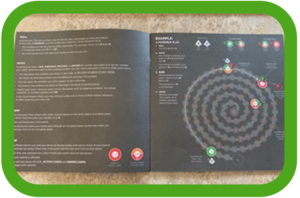
FUN FACTOR: ♥♥♥♥_ The tagline is “The Beautiful, Colorful, Mathematical Game, ” and it is! It has a very beautiful and bold appearance with its black background and color-coded spiral board. But, the tagline never mentions fun, though I think it should! No, it’s not fun enough that all of the neighborhood kids will want to come and play this instead of the PS4 but it is fun! It’s especially fun when you have played a few turns and players start to bump one another back to start. And the fun is significantly increased when players really start to strategize instead of just relying on luck. FUN FACTOR SCORE: 4/5 ♥♥♥♥_

EDUCATIONAL LEVEL: ♥♥♥♥♥ If you are looking for a game that allows for practicing all four operations, pushes kids to strategize and really hounds the concept of factors and prime, this is a GREAT game! I would classify this as the math game with the HIGHEST EDUCATIONAL VALUE of every math game we have tried! It’s a wee bit on the expensive side, but the depth of the EDUCATIONAL VALUE makes it well worth it, in my opinion. EDUCATIONAL LEVEL SCORE: 5/5 ♥♥♥♥♥
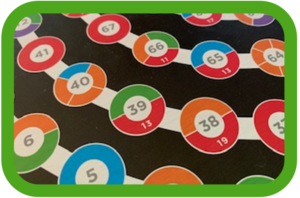
ORGANIZATIONAL COMPONENT: ♥♥♥♥♥ Prime Climb is designed beautifully with quality pieces, though the pawns could probably take an upgrade. The box is sturdy, but not small. It does have a divider insert which helps keep things neat. The board is the fold-out type and is very well-made and easy to fold/unfold. ORGANIZATIONAL COMPONENT: 5/5 ♥♥♥♥♥

OVERALL SCORE: ♥♥♥♥♥ This game has ousted FLIP IT for the top spot and is now our favorite math game! Not only is it fun, but it offers the opportunity to push players to the next level of understanding math. It also offers practice with all four operations and allows players to strategize or just go with sheer luck! It’s especially great for older kids who need practice because it definitely gives off an older-kid vibe with its style and strategy. OVERALL SCORE: 95% ♥♥♥♥♥
If you are ready to play “the beautiful, colorful, mathematical game,” you can grab it here on Amazon.
If you want to look more closely at HOW to play Prime Climb, keep reading….
STEP ONE: Unfold the board and put it in the middle of the playing area.
STEP TWO: Remove the blank cards from the pile, shuffle the remaining cards and place them in a pile so that all players have access.
STEP THREE: Each player chooses their pawn color and places BOTH on “0”. For our example, we only have two players {yellow and blue.}

STEP FOUR: Decide who will go first.
TIP: A turn consists of four phases: ROLL, MOVE, BUMP, DRAW
STEP FIVE: Player One ROLLS the dice.

STEP SIX: Player One needs to decide what to do with each die. Each die needs to be applied to a pawn. Each die is applied by either adding, subtracting, multiplying or dividing it with the number that pawn is on. Because it’s on 0, the only option is to add it. So, Player One adds the 7 die to one pawn and MOVES it to 7. Then Player One adds the 10 die to the other pawn and MOVES it to 10.
NOTE: Player One could’ve applied both die to one pawn and moved to 17.
STEP SEVEN: If another player’s pawns were on one of those new spots, Player One would BUMP it back to 0. But there are no pawns to BUMP so that part is done for this turn.
STEP EIGHT: If Player One has a pawn on an entirely red space, he gets to DRAW a card. But he didn’t, so there is no card to DRAW this time.
STEP NINE: Player Two takes a turn. ROLL. MOVE. BUMP. DRAW.
STEP TEN: Player One takes another turn. This time he ROLLS 10 and 4.

STEP ELEVEN: Player One uses the 4 die and adds it to the 7 that it’s on and MOVES that pawn to 11. Then he uses the 10 die and multiplies it with the 10 spot and MOVES that pawn to 100.

STEP TWELVE: No pawns to BUMP.
STEP THIRTEEN: Because Player One has a pawn on an all-red spot {11}, he gets to DRAW a card. It’s a KEEPER card that he can use on a future turn. So, his turn is now over.

STEP FOURTEEN: Player Two takes a turn.
STEP FIFTEEN: Player One ROLLS a 3 and 11. Player One adds the 11 to the 8 spot and MOVES to 19. He then subtracts the 3 from the 100 spot and MOVES to 97.
NOTE: You MUST land on 101 exactly. Player One could not have added 3 to the 100 spot and moved to 101. It must be exact.
STEP SIXTEEN: No pawns to BUMP.
STEP SEVENTEEN: Because Player One landed on an all-red spot, he gets to DRAW a card. It’s another KEEPER card to use on a future turn.

NOTE: Even though Player One was on TWO red spots, he only got to DRAW one card. Only one card can be drawn per turn.
STEP EIGHTEEN: Player Two takes a turn.
STEP NINETEEN: Player One ROLLS a 4 and 5. Player One adds the 4 to the 97 spot and MOVES to 101! That pawn is done and can be removed from the board! Player One is halfway to winning!

STEP TWENTY: He then subtracts the 5 from the 19 spot and MOVES to 14 where Player Two has a pawn. Player One BUMPS this pawn back to 0 and takes over the 14 spot.
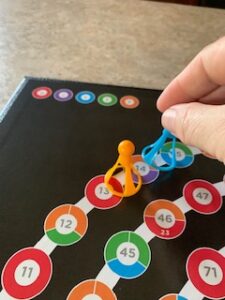
STEP TWENTY-ONE: Player One does not DRAW a card because he is not on an all-red spot. His turn is over.
STEP TWENTY-TWO: Play continues until either Player One gets his remaining pawn to 101 or Player Two gets both of his pawns to 101.